Mailchimp Email Template: No HTML Needed
As a designer and strategist, I have seen countless businesses struggle with the technical barrier of email marketing. You know the drill: you have a fantastic product, a loyal customer base, and a story to tell, but the moment you open a code editor, the creativity drains away. This is precisely why the concept of a Mailchimp Email Template: No HTML Needed is such a critical asset for modern commerce. It shifts the focus from wrestling with code to connecting with people. When you remove the requirement to write HTML, you unlock a workflow where visual storytelling takes the lead, allowing furniture shops, boutiques, and e-commerce brands to build campaigns that feel less like technical broadcasts and more like curated digital magazines.
The Visual Language of Effortless Design
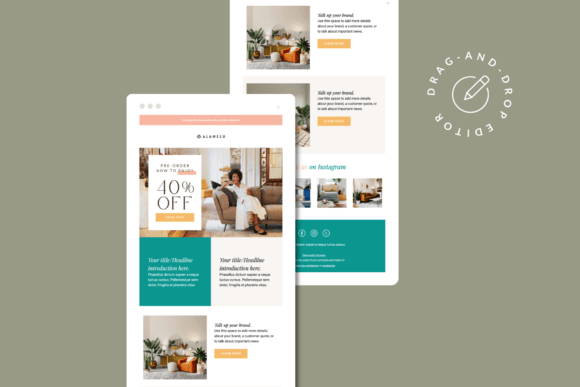
The personality of a Mailchimp Email Template: No HTML Needed is defined by its inherent flexibility and professional polish. Visually, these templates are designed with a modular architecture. Think of them as a high-quality editorial design system where every block—whether it is an image, a text header, or a call-to-action button—snaps into a harmonious grid. The visual characteristics often lean towards modern typography, utilizing clean sans serif fonts for body text to ensure maximum readability across mobile devices, while offering space for bold, display fonts in the headers to grab attention.
The overall appeal lies in the balance between structure and freedom. While the layout is rigid enough to prevent design disasters (like images breaking on Outlook), it is fluid enough to accommodate a wide range of aesthetics. Whether you are a crafter aiming for a warm, handwritten font vibe or a tech startup requiring a sleek, minimalist serif font hierarchy, the template adapts. It provides the scaffolding for a strong brand identity without demanding that you lay every brick manually. This approach ensures that the visual weight is distributed correctly, guiding the reader’s eye naturally from the hero image down to the footer.
Strategic Applications for Brand Consistency
Understanding where this template ecosystem works best requires looking at the lifecycle of a customer interaction. For e-commerce stores, the Mailchimp Email Template: No HTML Needed is invaluable for product launches. You can utilize the drag-and-drop builder to showcase high-resolution product photography, pairing it with a complementary creative font that evokes the texture of the product—be it leather, wood, or silk. This is not just about sending an email; it is about creating a tactile experience through web design principles applied to the inbox.
For publishers and bloggers, the value lies in visual hierarchy. A newsletter is a digest of information, and without clear typographic markers, the content becomes a wall of text. By utilizing the pre-styled sections, you can create distinct zones for featured articles, sidebars, and social media callouts. This structure influences how your audience perceives your professionalism. A consistent layout, powered by reliable design assets, signals to the reader that you are a trustworthy source of information. It enhances brand recognition; over time, your subscribers will recognize your email structure before they even read the sender name.
Practical Guidance on Implementation and Pairing
Choosing to use a Mailchimp Email Template: No HTML Needed does not mean you abdicate your role as a designer; rather, you elevate it to a strategic level. When you receive your template package, you are getting more than just a file; you are getting a workflow. The inclusion of a Canva Design Link for the hero banner is a prime example of practical utility. It allows you to customize the most visual part of your email using a tool you are likely already familiar with, ensuring that your logo design and campaign imagery are perfectly aligned with your current aesthetic.
Evaluating the fit of the template involves looking at the included styles and the fallback mechanisms. In email marketing, not all clients support advanced features. A robust template utilizes a fallback font—often a standard sans serif font like Arial or Helvetica—for email clients that do not support Google Fonts. This ensures that your readability never suffers, regardless of whether your client is using Apple Mail or an older version of Outlook. When testing font pairings, look at how the template handles contrast. Does the header weight balance the body text? Does the button text stand out enough to drive engagement without shouting? These are the nuances that separate amateur blasts from professional campaigns.
Leveraging Drag-and-Drop for Commercial Success
The true power of a Mailchimp Email Template: No HTML Needed is realized when you start customizing it for commercial intent. Because no coding is required, you can iterate rapidly. If a sale isn't performing, you can duplicate the campaign, swap the color palette, change the typeface styling on your headlines, and resend—all within minutes. This agility is crucial for A/B testing.
Furthermore, the integration of packaging design elements into your email strategy becomes seamless. If your brand identity relies on specific textures or patterns, you can upload these as background images or dividers within the template blocks. This creates a cohesive journey from the inbox to the unboxing experience. For small business owners, this level of professionalism was once the domain of agencies with large budgets. Now, with tools like the Mailchimp Drag & Drop Email Template Builder, you have agency-level control over your digital and print integration.
Maximizing Engagement Through Visual Storytelling
Ultimately, the goal of any premium font or template system is engagement. A Mailchimp Email Template: No HTML Needed allows you to focus on the story rather than the syntax. When you aren't worrying about closing a For designers and content creators, this tool serves as a bridge between concept and execution. It allows for the application of social media graphics aesthetics—bold, visual, and fast-paced—within the more formal structure of an email. By treating the email template as a dynamic canvas rather than a static document, you foster a deeper connection with your audience. The result is a newsletter that doesn't just inform but captivates, driving the kind of loyalty and revenue that sustains a growing business.🔗 You Might Also Like